ABC Accelerator
Overview
The ABC Accelerator is a CITYlayers service designed for building portfolio managers seeking prioritized sustainability recommendations for their buildings. It combines data analysis with expert assessment to identify actionable improvements across buildings, energy systems, and public spaces.
Features
Building Selection
Via polygon selection, users can select up to 100 buildings of interest. Once selected, buildings can be further refined through manual filtering to focus on specific subsets of the portfolio.
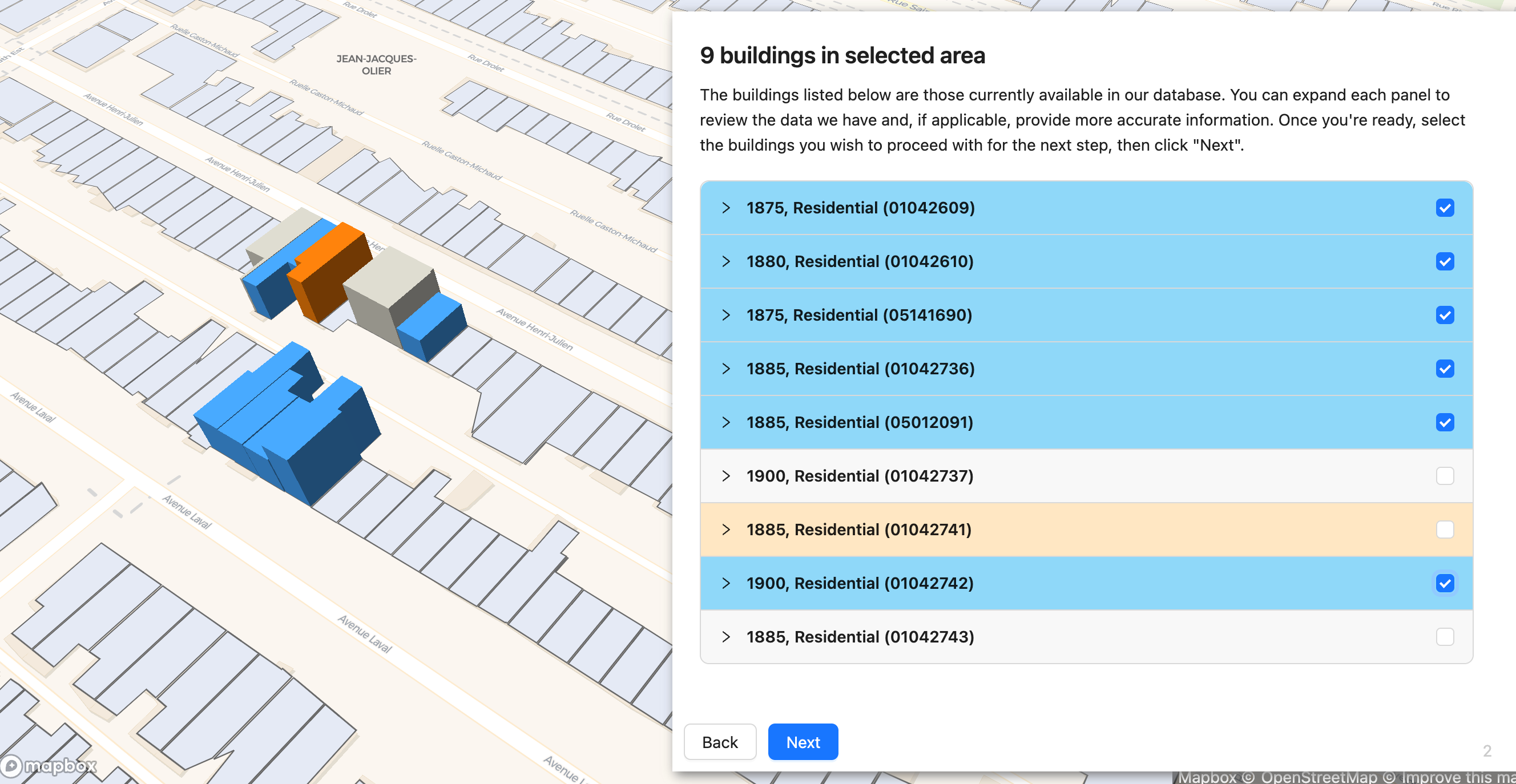
Building Data Assessment
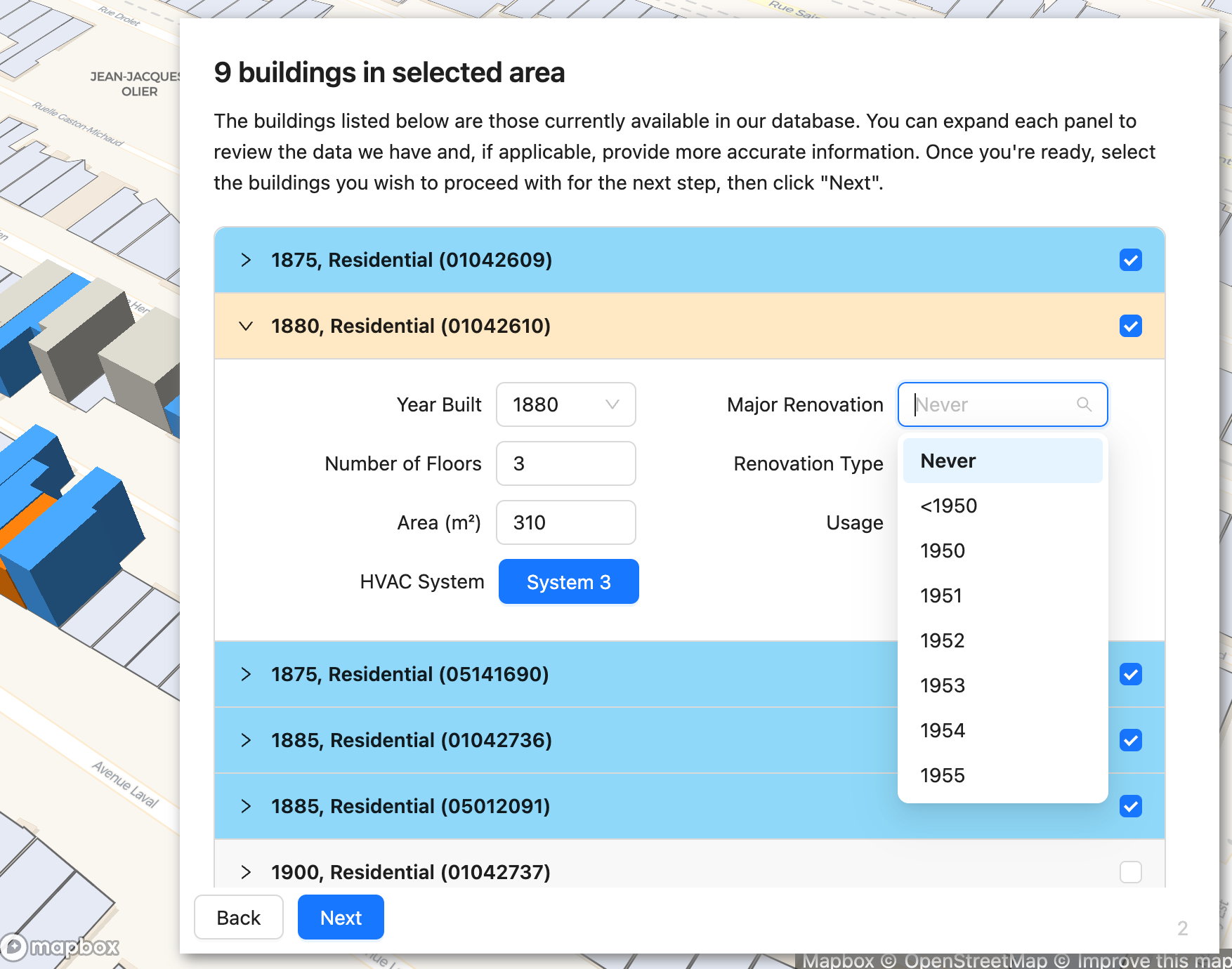
The ABC Accelerator displays available open-source and statistically-inferred data for the selected buildings. Users can supplement this data by inputting their own detailed building data, ensuring recommendations are based on the most accurate available information.
Sustainability Assessment
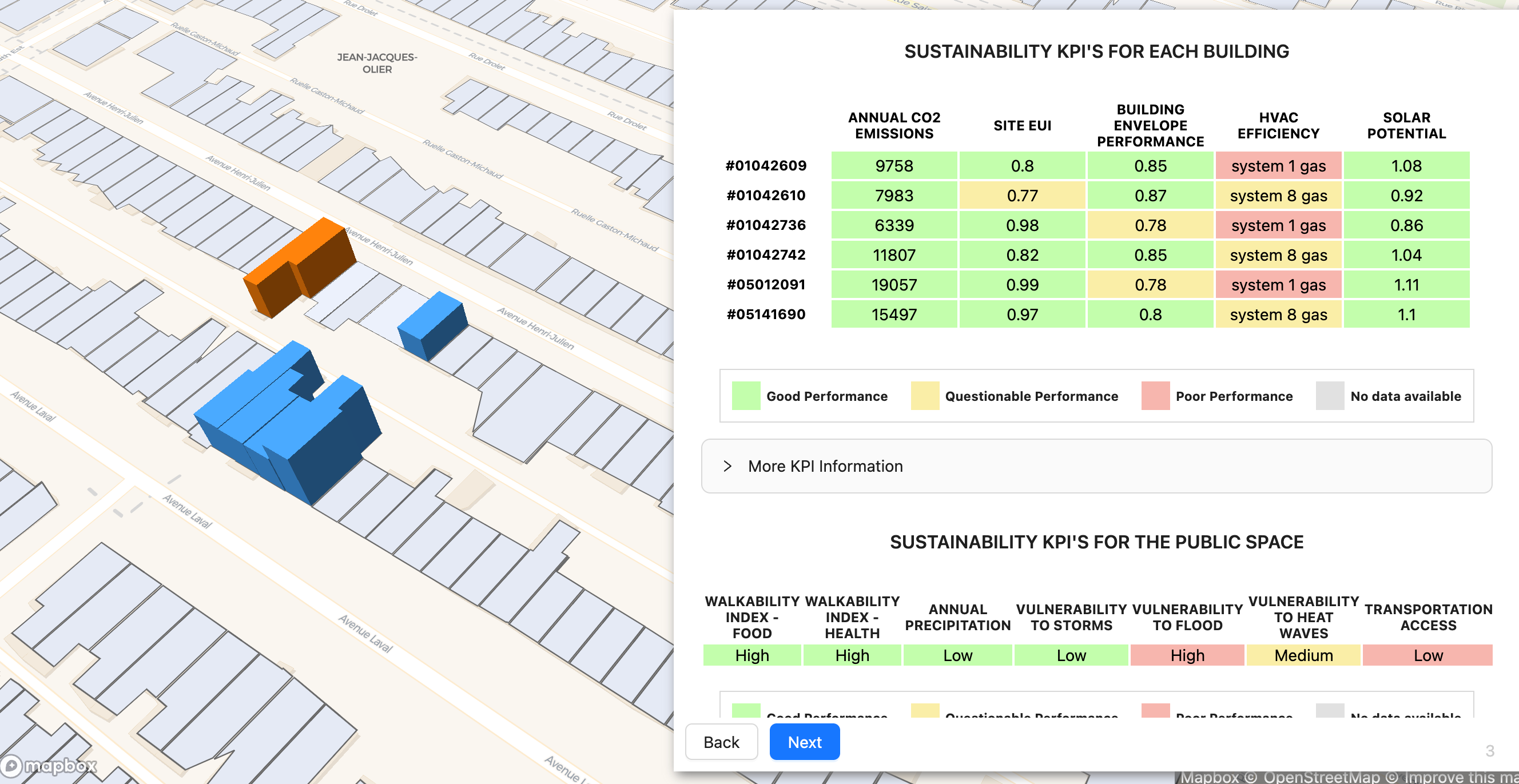
The ABC Accelerator provides a sustainability assessment across two dimensions: buildings and public spaces. Six building KPIs are displayed in a table for each building, while seven public space KPIs are apply to the selection as a whole.
Buildings
Annual CO₂ emissions: Annual CO₂ emissions due to building energy consumption in kgCO₂e.
Site EUI (Energy Use Intensity): Energy use intensity in gigajoules per m².
Building envelope performance: The ratio between the building’s total energy consumption assuming the construction is up to code according to the publicly available year of construction of the building (current status) vs the energy consumption assuming the building has been retrofitted to meet the latest code requirements as of 2025 (skin retrofit).
HVAC efficiency: Energy efficiency score of the building’s HVAC system. Every HVAC system in our catalog maps to one qualitative label (good, reasonable, bad). More details about this mapping will be added to this Wiki in the future.
Solar potential: The ratio of a building’s specific PV production to the benchmark value of 1,328 kWh/kWp in Montreal. A ratio close to 1 indicates good performance (green).
Public Spaces
Walkability Index - Food: Walk score based on proximity to food services.
Walkability Index - Health: Walk score based on proximity to healthcare services.
Annual Precipitation: The average annual precipitation in the area the building is located. A cell coloured in red indicates this area receives some of the highest rainfall levels in the region.
Vulnerability to Storms: An indicator of how vulnerable a building is against storms. A cell coloured in red indicates this area is among the most vulnerable in the region.
Vulnerability to Flood: An indicator of how vulnerable a building is against floods. A cell coloured in red indicates this area is among the most vulnerable in the region.
Vulnerability to Heat Waves: A qualitative measure of how the region is impacted by heat waves. A cell coloured in red indicates this area is among the most vulnerable in the region.
Transportation Access: If public transport is available within a 1 km radius of the building, this indicator will be shown in green. Otherwise, it will be shown in red.
Sustainability Recommendations
The ABC Accelerator provides recommendations on three aspects of the portfolio:
Buildings: Envelope performance and energy consumption/metering improvements.
Energy Systems: Heating, cooling, ventilation performance improvements.
Public Spaces: Livability and community-focused improvements.
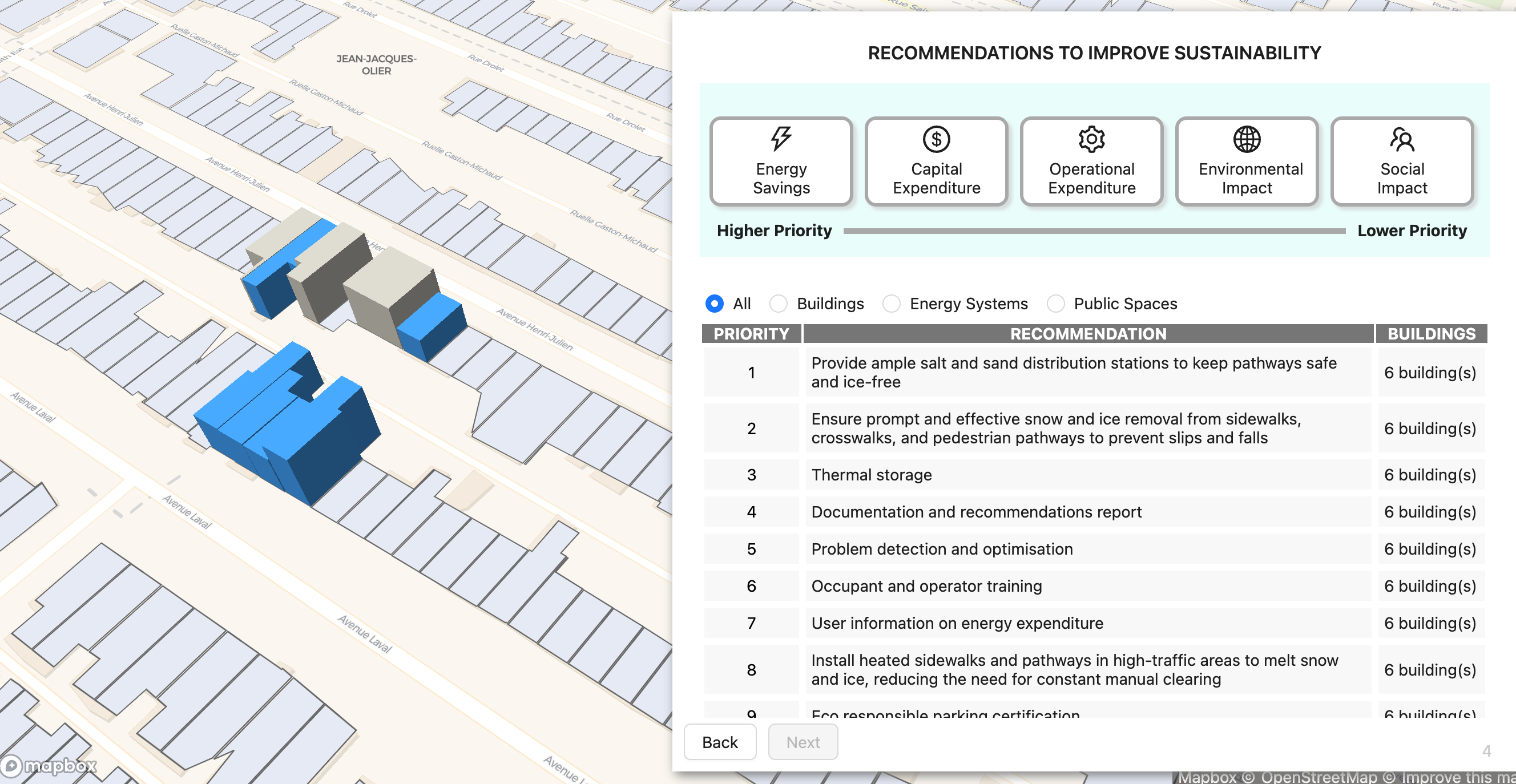
Recommendations are prioritized based on five criteria:
Energy Savings: decrease building energy consumption
Capital Expenditure: decrease capital expenditure on the building (e.g., major renovations)
Operational Expenditure: decrease building operational expenses (e.g., maintenance, repairs, utility bills, etc.)
Environmental Impact: increase environmental impact (e.g., by decreasing CO₂ emissions)
Social Impact: improve livability aspects in the building and its surroundings
Users decide the order of priority for these criteria, and the recommendation list updates instantly to reflect their choices.
Methodology
This section documents the analytical framework underlying the ABC Accelerator service (TBD).
Detailed explanation of the assessment methodology
Complete list of input datasets and data sources
Key assumptions and their justifications
References to relevant academic papers and standards